




Archived Event:
*** This event date has already passed. ***
Atascocita Event
Lecture: Eastern Hog-nosed Snake
Eastern Hog-nosed Snake (Heterodon platirhinos)
One of the more unusual reports that we receive at Jesse Jones Park & Nature Center is for someone to say that they have seen a cobra on a trail. Cobra? Yes, they report a cobra.
One of the more unusual reports that we receive at Jesse Jones Park & Nature Center is for someone to say that they have seen a cobra on a trail. Cobra? Yes, they report a cobra.
 Save event
Event Details:
Eastern Hog-nosed Snake (Heterodon platirhinos)
One of the more unusual reports that we receive at Jesse Jones Park & Nature Center is for someone to say that they have seen a cobra on a trail. Cobra? Yes, they report a cobra.
However, such a mistake can be forgiven somewhat due to the actual ophidian offender. While it is NOT a cobra, the Eastern Hog-nosed Snake (Heterodon platirhinos), is a species of mildly venomous rear-fanged snake in the family Colubridae. The species is endemic to North America and is found from eastern-central Minnesota, and Wisconsin to southern Ontario and extreme southern New Hampshire, south to southern Florida and west to eastern Texas and western Kansas.
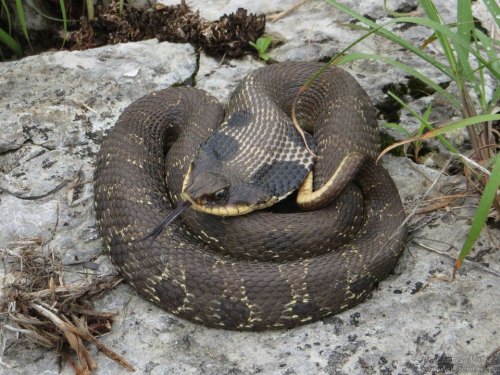
Hog-nosed snakes are some of the world's best actors. When it is threatened, the neck is flattened and the head is raised off the ground - yes, like a cobra. It also hisses and will strike with its mouth closed, but it does not attempt to bite. The result can be likened to a high-speed head-butt. If this threat display does not work to deter a would-be predator, an eastern hognose snake will often roll onto its back and play dead, going so far as to emit a foul musk from its cloaca and let its tongue hang out of its mouth.
To learn more about this unusual snake, come to the Nature Center at 10 am on Saturday, September 22, for a closer look at this interesting ophidian that can be found in Jesse Jones Park.
The genus name Heterodon is derived from the Greek words heteros meaning "different" and odon meaning "tooth." The specific name platirhinos is derived from the Greek words platys meaning "broad or flat" and rhinos meaning "snout". The most distinguishing feature is the upturned snout, which slightly resembles the nose of a pig, used for digging in sandy soils. Hence, it got the name Hog-nosed Snake.
Although it is a rear-fanged snake, it is often considered nonvenomous because it is not harmful to humans. As previously mentioned, Heterodon means "different tooth", which refers to the enlarged teeth at the rear of the upper jaw. These teeth inject a mild amphibian-specific venom into prey. The fangs receive the venom from the snake's Duvernoy's gland. Bitten humans who are allergic to the saliva have been known to experience local swelling, but no human deaths have been documented.
The Eastern Hog-nosed Snake feeds extensively on amphibians, and has a particular fondness for toads. This snake has resistance to the toxins toads secrete. This immunity is thought to come from enlarged adrenal glands which secrete large amounts of hormones to counteract the toads' powerful skin poisons. At the rear of each upper jaw, it has greatly enlarged teeth, which are neither hollow nor grooved, with which it punctures and deflates toads to be able to swallow them whole. It will also consume other amphibians, such as frogs and salamanders. Because it is a toad-feeding specialist, its venom has been modified to be greatly effective against toads and has not been found to be harmful to humans.
Eastern Hog-nosed Snakes mate in April and May. Females lay their eggs in small soil depressions, mammal burrows, or under rocks. Some females have been observed traveling past viable nesting conditions to reach communal nesting sites. The females, which lay 8-40 eggs (averaging about 25) in June or early July, and do not take care of the eggs or young. The eggs, which measure about 33 mm × 23 mm (1.33 in × 1 in), hatch after about 60 days, from late July to September. The hatchlings are 16.5-21 cm (6.5-8.3 in) long. They have an average nest temperature of 23-26 degrees Celsius (73.4-78.8 degrees Fahrenheit) incubating for an average of 49-63 days.
The average adult measures 71 cm (28 in) in total length (including tail), with females being larger than males. The maximum recorded total length is 116 cm (46 in).
The color pattern is extremely variable. It can be red, green, orange, brown, gray to black, or any combination thereof depending on locality. Dorsally, it can be blotched, checkered, or patternless. The belly tends to be a solid gray, yellow, or cream-colored. In this species the underside of the tail is lighter than the belly.
These snakes live for approximately 12 years. They shed their skin periodically to grow and develop.
Eastern Hog-nosed Snakes are still quite common in Jesse Jones Park. If you should encounter one, and it starts acting like a cobra, just enjoy the show but remember - unless you are secretly a toad disguised as a human - you have nothing to worry about!
One of the more unusual reports that we receive at Jesse Jones Park & Nature Center is for someone to say that they have seen a cobra on a trail. Cobra? Yes, they report a cobra.
However, such a mistake can be forgiven somewhat due to the actual ophidian offender. While it is NOT a cobra, the Eastern Hog-nosed Snake (Heterodon platirhinos), is a species of mildly venomous rear-fanged snake in the family Colubridae. The species is endemic to North America and is found from eastern-central Minnesota, and Wisconsin to southern Ontario and extreme southern New Hampshire, south to southern Florida and west to eastern Texas and western Kansas.
Hog-nosed snakes are some of the world's best actors. When it is threatened, the neck is flattened and the head is raised off the ground - yes, like a cobra. It also hisses and will strike with its mouth closed, but it does not attempt to bite. The result can be likened to a high-speed head-butt. If this threat display does not work to deter a would-be predator, an eastern hognose snake will often roll onto its back and play dead, going so far as to emit a foul musk from its cloaca and let its tongue hang out of its mouth.
To learn more about this unusual snake, come to the Nature Center at 10 am on Saturday, September 22, for a closer look at this interesting ophidian that can be found in Jesse Jones Park.
The genus name Heterodon is derived from the Greek words heteros meaning "different" and odon meaning "tooth." The specific name platirhinos is derived from the Greek words platys meaning "broad or flat" and rhinos meaning "snout". The most distinguishing feature is the upturned snout, which slightly resembles the nose of a pig, used for digging in sandy soils. Hence, it got the name Hog-nosed Snake.
Although it is a rear-fanged snake, it is often considered nonvenomous because it is not harmful to humans. As previously mentioned, Heterodon means "different tooth", which refers to the enlarged teeth at the rear of the upper jaw. These teeth inject a mild amphibian-specific venom into prey. The fangs receive the venom from the snake's Duvernoy's gland. Bitten humans who are allergic to the saliva have been known to experience local swelling, but no human deaths have been documented.
The Eastern Hog-nosed Snake feeds extensively on amphibians, and has a particular fondness for toads. This snake has resistance to the toxins toads secrete. This immunity is thought to come from enlarged adrenal glands which secrete large amounts of hormones to counteract the toads' powerful skin poisons. At the rear of each upper jaw, it has greatly enlarged teeth, which are neither hollow nor grooved, with which it punctures and deflates toads to be able to swallow them whole. It will also consume other amphibians, such as frogs and salamanders. Because it is a toad-feeding specialist, its venom has been modified to be greatly effective against toads and has not been found to be harmful to humans.
Eastern Hog-nosed Snakes mate in April and May. Females lay their eggs in small soil depressions, mammal burrows, or under rocks. Some females have been observed traveling past viable nesting conditions to reach communal nesting sites. The females, which lay 8-40 eggs (averaging about 25) in June or early July, and do not take care of the eggs or young. The eggs, which measure about 33 mm × 23 mm (1.33 in × 1 in), hatch after about 60 days, from late July to September. The hatchlings are 16.5-21 cm (6.5-8.3 in) long. They have an average nest temperature of 23-26 degrees Celsius (73.4-78.8 degrees Fahrenheit) incubating for an average of 49-63 days.
The average adult measures 71 cm (28 in) in total length (including tail), with females being larger than males. The maximum recorded total length is 116 cm (46 in).
The color pattern is extremely variable. It can be red, green, orange, brown, gray to black, or any combination thereof depending on locality. Dorsally, it can be blotched, checkered, or patternless. The belly tends to be a solid gray, yellow, or cream-colored. In this species the underside of the tail is lighter than the belly.
These snakes live for approximately 12 years. They shed their skin periodically to grow and develop.
Eastern Hog-nosed Snakes are still quite common in Jesse Jones Park. If you should encounter one, and it starts acting like a cobra, just enjoy the show but remember - unless you are secretly a toad disguised as a human - you have nothing to worry about!